Mali's Fragile State Under Siege: Rebel Alliances Challenge Government Grip
Coordinated attacks reveal deep security vulnerabilities as rival armed groups forge temporary alliances against the Malian state, raising fears of wider instability.
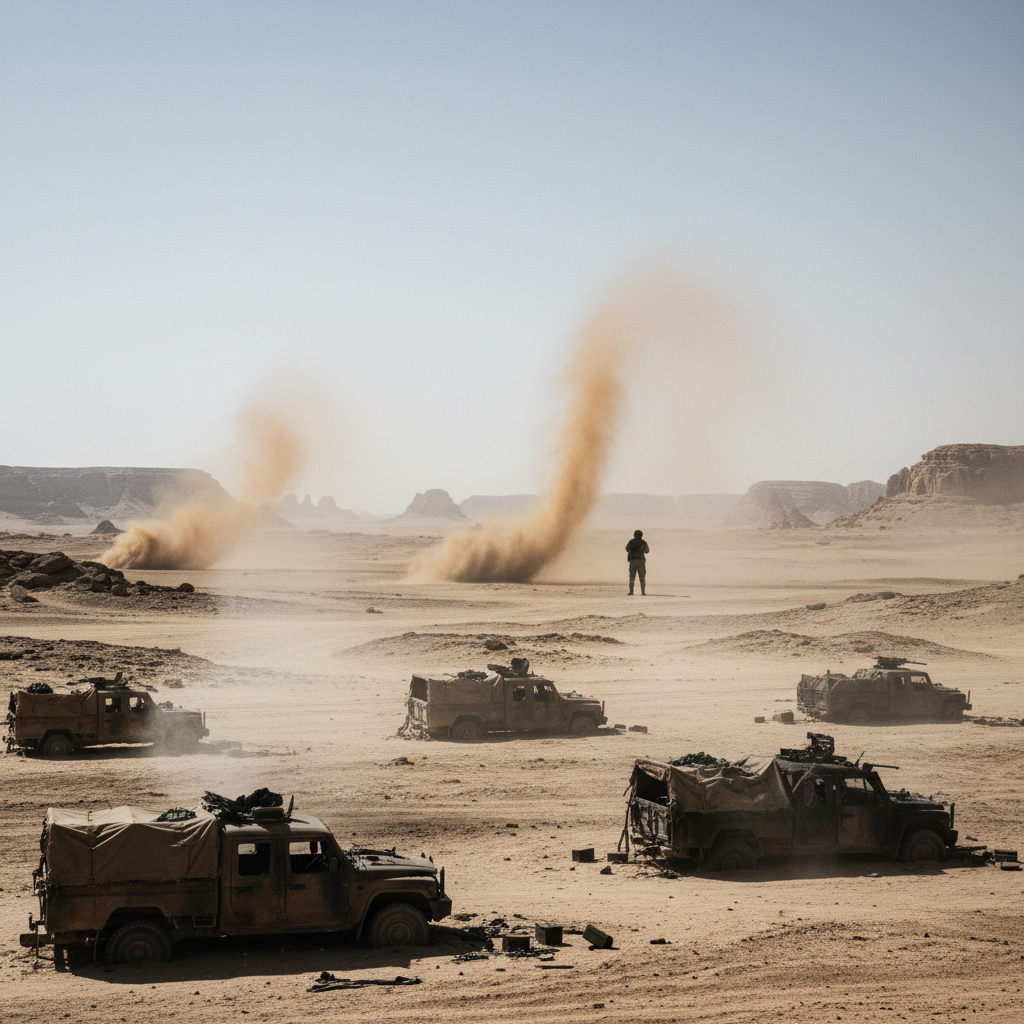
Mali is grappling with a significant security crisis following a wave of coordinated attacks by armed groups across the nation. Analysts note that these assaults have exposed critical vulnerabilities in the military-ruled government's ability to maintain order, particularly as international security forces withdraw and Russian mercenaries increase their presence.
Al-Qaeda Affiliate Claims Major Offensive
The Jama'at Nusrat al-Islam wal-Muslimin (JNIM), an al-Qaeda-linked group, has claimed responsibility for a series of attacks targeting military sites, including assaults within the capital, Bamako. In a significant development, JNIM announced a joint operation with the Azawad Liberation Front (FLA), a Tuareg-dominated rebel group, to capture the city of Kidal in the north. Sunday's developments were tragically marred by the death of Mali's Defence Minister, Sadio Camara, reportedly during these coordinated assaults.
"If they [armed groups] were able to cover almost the whole country in one day, it means there are security vulnerabilities in the system," Mathias Hounkpe, country director for the International Foundation for Electoral Systems in Mali, told Al Jazeera. "They have also been able to reach the city of Kati, where the president and other important ministers live. That is the centre of power and them having reached this point through attacks means the government’s ability to secure the country is weak."
Shifting Security Landscape
Since gaining independence in 1960, Mali has endured a turbulent history marked by political instability, military coups, and persistent violence from armed factions. The recent withdrawal of French and other international forces has created a security vacuum, which has been further complicated by the growing influence of Russian mercenary groups over the past two years, contributing to escalating violence.
Key Armed Factions
The security landscape in Mali has been complex since 2012, with various separatist and extremist groups vying for influence. JNIM, formed in 2017, is a prominent coalition of groups including the Saharan branch of al-Qaeda in the Islamic Maghreb (AQIM) and Malian factions. Led by Iyad Ag Ghali, JNIM commands an estimated 10,000 fighters and adheres to al-Qaeda's ideology, aiming to combat Western influence and enforce strict Islamic law. The group has previously targeted military bases, including a significant attack on the Kati army base near Bamako in 2022, and has disrupted essential supply lines, such as fuel tankers, by imposing blockades.
In the north, the Azawad Liberation Front (FLA) emerged in 2024 as a coalition of separatist forces seeking an independent region of Azawad. Led by Alghabass Ag Intalla, the FLA has been actively fighting against the Malian government and Russian forces in the region.
An Unstable Alliance
Historically, JNIM and the FLA have been rivals, clashing over territorial control and ideological differences. JNIM's objectives focus on imposing its interpretation of Islamic law across Mali, while the FLA's primary goal is regional autonomy. Despite their divergent aims and past conflicts, the recent joint offensive signals a pragmatic, albeit temporary, alliance forged to challenge the state's authority.
This evolving dynamic between armed groups, coupled with the weakening of state institutions and the presence of foreign forces, paints a precarious picture for the future of Mali and the wider Sahel region.
Synthesized from primary source
Al Jazeera — https://www.aljazeera.com/news/2026/4/27/rival-armed-groups-join-forces-against-the-malian-state-what-next